
Sherry warned that Pakistan would respond if India attacked, stressing that the delegation’s aim was to promote peace and dialogue.
- If IWT is ignored, no future agreement will have any value: Butt
- Sabzwari says India is seeking “immunity for aggression”. Dastagir says
- India wants neither impartial inquiry nor talks.
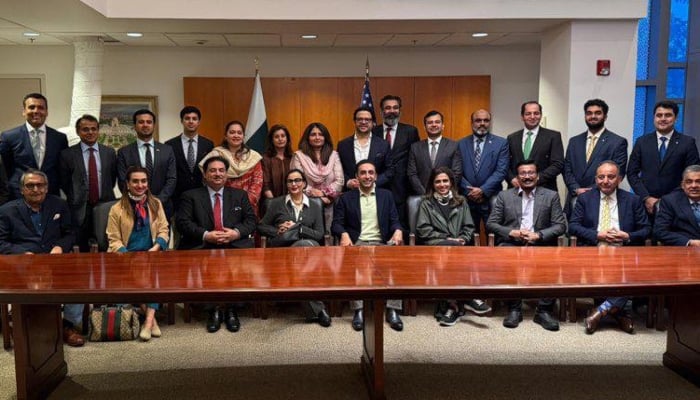
London: A high-level Pakistani diplomatic delegation has arrived in the UK after completing a series of positive meetings with US Congress members and senators in Washington and New York.
A nine-member delegation led by former foreign minister and Pakistan Peoples Party (PPP) chairman Bilawal Bhutto Zardari engaged in more than 50 meetings over five days to present Pakistan’s position on regional peace and disputes with India and highlight New Delhi’s provocations and aggression against Islamabad.
The delegation includes Hina Rabbani Khar, Senator Sherry Rehman, Dr. Mosaddiq Malik, Khurram Dastgir Khan, Jalil Abbas Jilani, Tehmina Janjua, Bushra Anjum Butt and Syed Faisal Sabzwari.
The recent conflict between the nuclear-armed countries was sparked by New Delhi’s April 22 attack in Pahalgam, IIOJK, where gunmen killed at least 26 civilians. India called it an act of organized terrorism by Pakistan, Islamabad leaders denied the claim. India then attacked Pakistan, leading to days of military engagement between the two neighbors.
Senator Rehman said he had positive meetings with US lawmakers who understood Pakistan’s position.
“Everyone agreed that weaponizing water is dangerous,” he said, adding: “India’s identity is becoming a warrior state.” He asserted that the IIOJK has become the largest open-air prison.
Sherry also made it clear that the Pakistani delegation was not “chasing” the Indian delegation, pointing to the simultaneous visits of Pakistani and Indian delegations to the United States. He said: “Our story is our own story.”
He further warned that Pakistan would respond if India attacked, and stressed that “our goal is to promote peace and dialogue”.
Sherry said that Pakistan has “more grievances against India” and suggested that the Indian delegation’s sole purpose was to defame Pakistan, while the delegation had gone to the US to “tell Pakistan’s story”.
Sabzwari, another member of the diplomatic delegation, said that their visit began at the United Nations where they presented Pakistan’s case.
“Although we have demonstrated military superiority, we have come to invite peace,” Sabzwari said. He wanted world powers to send a message to India that “two nuclear powers cannot thrive in such a dangerous environment.
He said India was “trying to claim immunity from aggression without evidence,” referring to the Pahalgam incident after which India attacked civilian infrastructure on Pakistani soil despite demands for evidence.
He said Pakistan wanted the current ceasefire to lead to “permanent peace.” He said the country’s position had been presented to the US State Department and members of parliament, and their “peace-oriented stance has been largely welcomed.” He also said he had brought a message of peace to the region, which was India’s failure and Pakistan’s success.
‘Life and death’
Meanwhile, Dastgir stressed that the water issue is a matter of life and death for Pakistan and we will not back down from it.
He noted that the Americans initially believed that a ceasefire brokered by President Donald Trump meant that no further intervention was needed. Dastgir explained that our mission was to convince them that intervention was necessary because India wanted neither an impartial inquiry nor talks.
Another member of the delegation, Jilani, said that there were good discussions with all members of the UN Security Council. He said that we also met with the UN Secretary-General and the President of the UN General Assembly.
He reiterated Pakistan’s position that “India committed aggression and Pakistan is a peace-loving country.” He said that Pakistan has been urging India to resolve issues peacefully for a long time. He said that Pakistan’s response to Indian aggression has dealt a blow to India’s image in the world.
The former caretaker foreign minister further said that India’s long-standing allegations against Pakistan have been rejected by the international community and the false impression of India being a great power has been dispelled.
He said that if Pakistan and India go to war, the entire region is affected. Pointing to Islamabad’s diplomatic success, he said that Pakistan got a “better response in America”.
He highlighted that Pakistan is calling it a ceasefire, while India is calling it a pause. He expressed fear that if the Kashmir and IWT issues are not resolved now, the issue will escalate again in six months and urged US President Trump to play a role in preventing the region from being affected by war.
Earlier on Saturday, Bilawal said that the recent five-day conflict, instead of exposing India as a so-called “net security provider”, has exposed it as a source of insecurity for South Asia and the wider international community.
“India’s actions have dangerously reduced the threshold of armed conflict in the region… They started a war based on lies and could not even win it,” he said while addressing a luncheon hosted by Pakistan’s Ambassador to the US Rizwan Saeed in honor of a Pakistani multi-party delegation in Washington DC.
Addressing the luncheon participants, Bilawal Bhutto said that India has long presented itself as a stable power before the West, especially the United States, by justifying foreign aid and defense deals.
“American taxpayer dollars are subsidizing India’s military-industrial complex under the illusion that it provides regional stability. But these five days of conflict have proven otherwise,” he said, emphasizing that peaceful and stable relations between India and Pakistan are the only viable path to security in South Asia.
 Tareekh e Islam TV
Leave a comment